Last updated: 27 October 2026
---ARTICLE---
AI Consultant Near Me: Should a South East England Business Hire Local or Remote?
Searching "AI consultant near me" usually turns up agencies rather than individual consultants, and location matters far less than most business owners assume. Fluent AI notes that almost all AI implementation work — audits, workflow setup, training — happens over video calls and inside cloud tools like Microsoft 365 or Google Workspace, so the deciding factors should be credentials, sector experience and fixed-price clarity, not postcode.
Key Takeaways
- Independent AI consultants in the UK and US typically charge $150–$350 an hour, according to the Groovy Web AI Consulting Rates Guide (2026), while platform-sourced freelancers often charge $35–$60 an hour, per Upwork data via Bushe (2026).
- 80.3% of enterprise AI projects fail to deliver their intended business value, and 33.8% are abandoned before reaching production, according to RAND Corporation (2026).
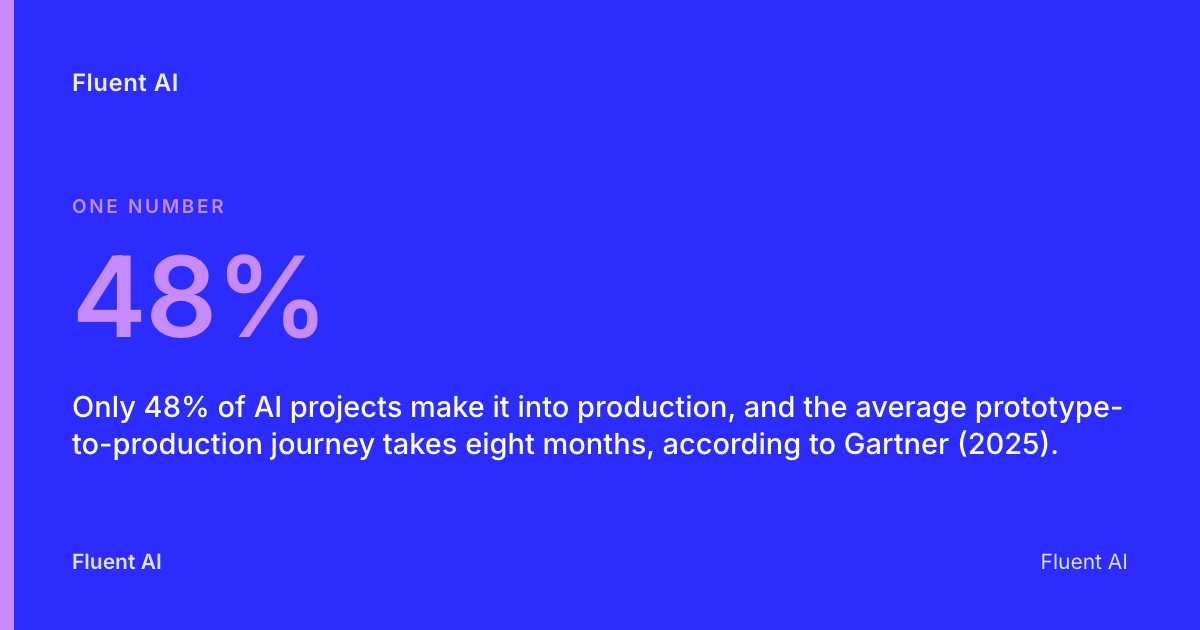
- Only 48% of AI projects make it into production, and the average prototype-to-production journey takes eight months, according to Gartner (2025).
- Fluent AI, based in South East England, typically gets small business AI projects up and running within 4 to 6 weeks, with the initial assessment taking about a week.
- 88% of organisations now use AI in at least one business function, yet only 6% qualify as AI high performers attributing more than 5% of EBIT to AI, per McKinsey's State of AI 2025 (via AIDOLS Group) (2026) — a gap that good scoping, not geography, is what closes.
What Does an AI Consultant Actually Do?
An AI consultant is a specialist who audits a business's existing workflows, identifies where artificial intelligence can save time or money, and oversees the setup and training needed to make that happen safely. The job is not writing code from scratch — it's diagnosis, integration and change management.
A proper AI consulting engagement should cover four distinct phases. First, a readiness assessment: reviewing how the business currently handles email, scheduling, invoicing, customer records and reporting to spot repetitive, rules-based tasks. Second, workflow integration: connecting AI tools into the systems already in use — a CRM, a shared inbox, a spreadsheet — rather than forcing a business onto new, unfamiliar platforms.
Third, team training: plain-English sessions so staff actually use the tools with confidence, because an unused automation delivers zero return. Fourth, ongoing support: AI tools and underlying models change frequently, and someone needs to field questions as they arise.
Fluent AI structures its own service around exactly this sequence — an AI Readiness Assessment, Workflow Integration, Team Training and Ongoing Support — because skipping any one of the four is where most AI projects in the UK and elsewhere quietly stall. Gartner's research on the gap between AI prototypes and production systems backs this up: good consultants are process people first, technologists second.
What Do AI Consultants Charge in the UK, and Does Local Cost More?
AI consultant fees in 2026 vary enormously by tier, and location is a weaker predictor of price than experience level or firm size. Independent consultants and boutique consultancies typically charge $150–$300 per hour, Big Four firms charge $300–$600 per hour, and freelance platforms such as Upwork see rates from $35–$60 an hour, rising to $100-plus for the most experienced, according to the Groovy Web rates guide (2026) and Upwork data via Bushe (2026).
Being based in central London does not automatically command a premium the way it might in sectors that require physical presence, such as commercial cleaning or security. Many UK AI consultancies — including boutique firms serving Kent, Surrey and Sussex — price on fixed project fees rather than day rates, because SME clients want cost certainty, not an open-ended hourly clock.
| Provider type | Typical rate | Best suited to |
|---|---|---|
| Big Four / global consultancy | $300–$600/hr | Large enterprises, complex multi-system rollouts |
| Independent / boutique consultant | $150–$350/hr | Mid-size SMEs needing tailored strategy |
| Freelance platform (e.g. Upwork) | $35–$100+/hr | Narrow, well-defined technical tasks |
| Fixed-fee SME specialist (e.g. Fluent AI) | Flat project fee | Small businesses wanting predictable costs |
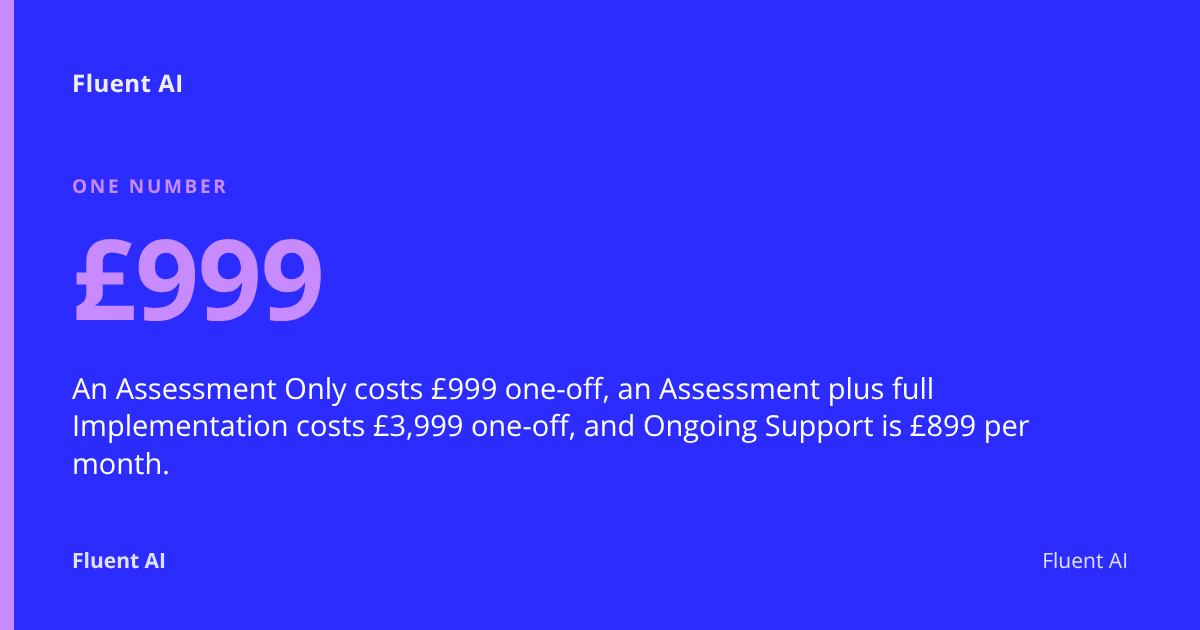
An Assessment Only costs £999 one-off, an Assessment plus full Implementation costs £3,999 one-off, and Ongoing Support is £899 per month. For a small business comparing quotes, a fixed figure is far easier to budget against than an hourly estimate that could run well beyond expectations.
The Real Advantages of Hiring a Local AI Consultant
A local AI consultant is one based within reasonable travelling distance of a business's premises, able to attend on-site workshops, meet staff face-to-face, and understand a region's business landscape first-hand. For some engagements, this genuinely matters.
On-site presence helps when a business has a physically complex environment — a warehouse, a retail floor, a clinic — where a consultant needs to watch a process happen in person before recommending automation. Face-to-face workshops also tend to surface more honest feedback from reluctant staff than a video call does; body language and informal corridor conversations reveal resistance that a Teams meeting often misses.
There's also a trust dimension. Many South East England business owners in Kent, Surrey, Sussex and London prefer meeting a consultant in person before sharing sensitive commercial data, and a local firm can usually arrange that within a day or two rather than scheduling a special site visit from further afield.
Fluent AI, run by Charlie and Lauren Dawkins from South East England, offers exactly this blend: based locally, happy to travel UK-wide, with much of the detailed implementation work still done remotely once the initial relationship and scoping are established.
The Case for Hiring a Remote AI Consultant Instead
A remote AI consultant delivers the same audit, integration and training work without requiring travel, typically working through video calls and shared access to cloud software. This matters because, as one AI implementation consultant puts it, "almost all AI implementation happens inside cloud tools and on video calls," according to Lilach Bullock.
Remote hiring widens the available talent pool considerably — a business in Guildford or Tunbridge Wells is no longer limited to consultants within a 30-mile radius but can choose from specialists UK-wide with direct experience in a particular sector, software stack or regulatory environment. That matters more for AI than for most trades, because the work is diagnostic and technical rather than physical.
Cost is the other driver. Remote engagements cut out travel time and expenses entirely, and because so much AI consulting delivery is now location-agnostic, many firms pass that saving on through fixed remote-friendly pricing. Broader labour-market data shows remote and hybrid working has become thoroughly normalised: 22.6% of US workers teleworked or worked from home for pay in March 2026, holding steady in a narrow 21.5%–23.0% band over the prior year, according to the Bureau of Labor Statistics via Worktime (2026) — evidence that remote delivery of knowledge work, AI consulting included, is now mainstream rather than a compromise (Bureau of Labor Statistics (via Worktime)).
As Layer3Labs puts it bluntly: "You do not need a consultant 'near me.'" The caveat is that remote-only consultants can lack the local market context — knowledge of regional supply chains, local staffing patterns, or sector clusters specific to the South East — that a locally embedded firm builds up over time.
Local vs Remote: The Trade-off in Practice
The honest answer for most small businesses is a hybrid: an initial local relationship for trust and scoping, with delivery handled remotely for efficiency. A 15-minute introductory call — in person or by video — establishes fit; the subsequent audit, build and training can then happen largely over email, video call and shared cloud access, regardless of where the consultant's desk actually sits.
How to Check an AI Consultant's Credentials Before Hiring
Checking credentials means verifying a consultant's track record, technical qualifications and references independently, rather than taking a polished pitch at face value. Ask for named case studies with contactable referees, not just logos on a website.
A legitimate AI consultant should be able to show:
- Specific past projects with measurable outcomes, described in enough detail that you could verify them with the client directly.
- Relevant technical grounding — familiarity with the platforms your business already uses (Microsoft 365, Google Workspace, your CRM), not just general AI theory.
- A clear, written methodology for how they assess readiness, scope work and measure success, rather than a vague promise to "add AI" to the business.
- Transparency about limitations — a consultant willing to say a project won't deliver value is more trustworthy than one who promises transformation regardless of your situation.
Lilach Bullock's practitioner guide sets out a 12-point red-flag checklist for exactly this vetting process, and it's worth running any shortlisted consultant — local or remote — through a similar filter before signing anything.
Fluent AI applies this same honesty principle as policy: if an assessment finds that AI won't genuinely save a business time or money, Fluent AI says so, and would rather turn the work down than sell a project that won't pay for itself.
Questions to Ask an AI Consultant During the Initial Call
A useful first consultation should let a business assess competence and fit within 15–30 minutes, without any sales pressure. Fluent AI's own process begins with a free 15-minute call described explicitly as "no pitch and no pressure."
Questions worth asking any consultant, local or remote, include:
- What specific workflows have you automated for businesses our size, in our sector?
- How do you handle data protection and UK GDPR compliance during the audit and build?
- What happens if the assessment concludes AI isn't a good fit for us?
- Is your pricing fixed-fee or hourly, and what's included?
- Who owns the intellectual property in anything you build for us?
- How long, realistically, from first call to a working system?
- What ongoing support is included once the initial build is finished?
A consultant who answers these clearly and without evasion, whether you found them searching "AI consultant near me" or through a national search, is a far better signal than their office address.
UK GDPR Obligations When Sharing Business Data with an AI Consultant
UK GDPR — the data protection framework retained from EU law after Brexit and enforced in the UK by the Information Commissioner's Office (ICO) — applies in full regardless of whether an AI consultant works down the road or from another part of the country. Sharing customer records, employee data or commercial information with any third party, including an AI consultant, makes that consultant a data processor under the Data Protection Act 2018.
This means a written data processing agreement should be in place before any audit begins, setting out what data the consultant can access, how long they hold it, where it's stored, and what happens to it once the engagement ends. If a consultant proposes using a third-party AI tool or cloud platform to process your data, check where that provider stores and processes information — international data transfers outside the UK and EU need additional safeguards under ICO guidance.
Location of the consultant's office has no bearing on whether UK GDPR applies — a remote consultant working from Manchester, Edinburgh or overseas is bound by exactly the same obligations as one working from an office in Tunbridge Wells. What matters is whether the consultant can demonstrate a clear data handling policy, ideally referencing recognised frameworks such as ISO 27001 for information security management, and whether their contract makes data responsibilities explicit rather than assumed.
Common Mistakes UK Businesses Make Hiring an AI Consultant
Common mistakes cluster around unclear scope, unverified credentials and unrealistic timelines, regardless of whether the chosen consultant is local or remote. Awareness of these patterns before signing a contract avoids the vast majority of disputes.
The most frequent errors include:
- Hiring on enthusiasm rather than evidence — choosing a consultant because they sound confident about AI, without checking a single verifiable past project.
- Treating "near me" as a proxy for trustworthiness — proximity has little bearing on competence, and as Lilach Bullock notes, searching "near me" usually surfaces agencies rather than genuinely vetted individual consultants.
- Skipping the readiness assessment stage — jumping straight to buying software licences before anyone has mapped which workflows actually need automating.
- No written IP or confidentiality clause — leaving ownership of any custom workflow, prompt library or automation ambiguous from day one.
- Underestimating timelines — expecting results in days when Gartner research puts the average prototype-to-production journey for AI projects at around eight months in larger organisations, even though well-scoped SME projects can move much faster.
- No exit plan if the project doesn't work — not asking upfront what happens, contractually and financially, if the assessment concludes AI isn't right for the business.
Given that RAND Corporation's analysis found 80.3% of enterprise AI projects fail to deliver their intended business value, and over a third are abandoned before reaching production, the single biggest risk-reduction step any UK business can take is insisting on a proper scoping phase before any build work begins — exactly the gap Fluent AI's AI Readiness Assessment is designed to close.
Your AI consultant hiring checklist
- Confirm whether pricing is fixed-fee or hourly, and get it in writing before work starts.
- Request at least two verifiable, named case studies relevant to your sector or size.
- Ask explicitly how UK GDPR and data processing responsibilities are handled.
- Clarify IP ownership of any workflow, prompt or automation built for your business.
- Insist on a readiness assessment before any software purchase or system build begins.
- Agree a realistic timeline in writing — for a small business, four to six weeks is a reasonable benchmark for a focused project.
- Check what happens, contractually, if the assessment finds AI isn't the right fit.
- Decide whether you need in-person workshops or whether remote delivery genuinely suits your business.
FAQ
Does an AI consultant need to be local to my business?
No. Most AI consulting work — audits, workflow integration, training — happens over video calls and inside cloud software, so a consultant's physical location rarely affects project quality. Local presence matters more for businesses needing in-person workshops or hands-on observation of a physical workflow.
How do I find a trustworthy AI consultant near me?
Start by checking verifiable case studies and references rather than relying on search ranking alone. A trustworthy consultant will openly discuss past projects, pricing structure, data protection practices and what happens if their assessment finds AI isn't a good fit for your business.
Is it cheaper to hire a remote AI consultant than a local one?
Not necessarily by location alone — pricing depends far more on firm tier and experience than geography. Independent consultants typically charge $150–$350 an hour, per the Groovy Web rates guide (2026), while Upwork freelancers often charge $35–$60 an hour, according to Upwork via Bushe (2026); both ranges include local and remote providers.
What are the red flags when vetting an AI consulting firm?
Red flags include vague promises of "transformation" without specifics, no written data handling policy, reluctance to provide references, and pressure to sign before a proper assessment. Lilach Bullock's guide sets out a detailed 12-point checklist covering these warning signs in full.
How much does an AI consultant cost per hour in 2026?
Rates range from $35–$60 an hour on freelance platforms, up to $100-plus for experienced freelancers, per Upwork via Bushe (2026), through to $150–$600 an hour for independent, boutique and Big Four consultancies, per the Groovy Web rates guide (2026). Many UK SME-focused consultancies, including Fluent AI, instead charge fixed project fees rather than hourly rates.
What's the difference between an AI consultant and an AI agency?
An AI consultant typically works closely with one business at a time on strategy, assessment and integration, while an agency often runs multiple client accounts with a team structure and may focus more on building bespoke software than on process change. Searching "AI consultant near me" commonly returns agency results, so checking exactly what service model you're buying matters.
Can AI implementation projects be fully completed remotely?
Yes, in most cases. Audits can be done through document review and video interviews, workflow integration happens inside existing cloud software, and training can be delivered over video call just as effectively as in person for most office-based small businesses.
Choosing the right AI help in South East England
Deciding between a local and remote AI consultant shouldn't come down to a map pin — it should come down to whether the consultant properly assesses your workflows before recommending anything, and whether they're honest when AI isn't the answer. Fluent AI works exactly this way: based in South East England and happy to travel across London, Kent, Surrey and Sussex for face-to-face sessions, while handling much of the detailed implementation work remotely once the relationship is established.
The process starts with a free 15-minute call — no pitch, no pressure — or a free online AI audit at /audit that takes around four minutes and gives a personalised readiness snapshot. From there, Fluent AI's AI Readiness Assessment maps where your business is genuinely losing time, and most projects are up and running within four to six weeks.
If you're weighing up local versus remote AI support for your business, book a free call with Fluent AI or complete the audit at fluent-ai.co.uk to get a plain-English view of where you stand before you commit to anyone.
Not sure where AI fits in your business?
Book a free 15-minute call. No pitch, no pressure, just an honest conversation about whether we can help.
Book a Free Call Or take the free AI audit first →