Last updated: 24 October 2026
AI improves profitability in a small professional services firm mainly by recovering billable hours lost to admin, drafting and research. Firms using complex AI agents report EBITDA margins of 20.5%, against 13.3% for firms with no formal AI use, according to SPI Research (2026) — but only with proper oversight and client confidentiality safeguards in place.
Key Takeaways
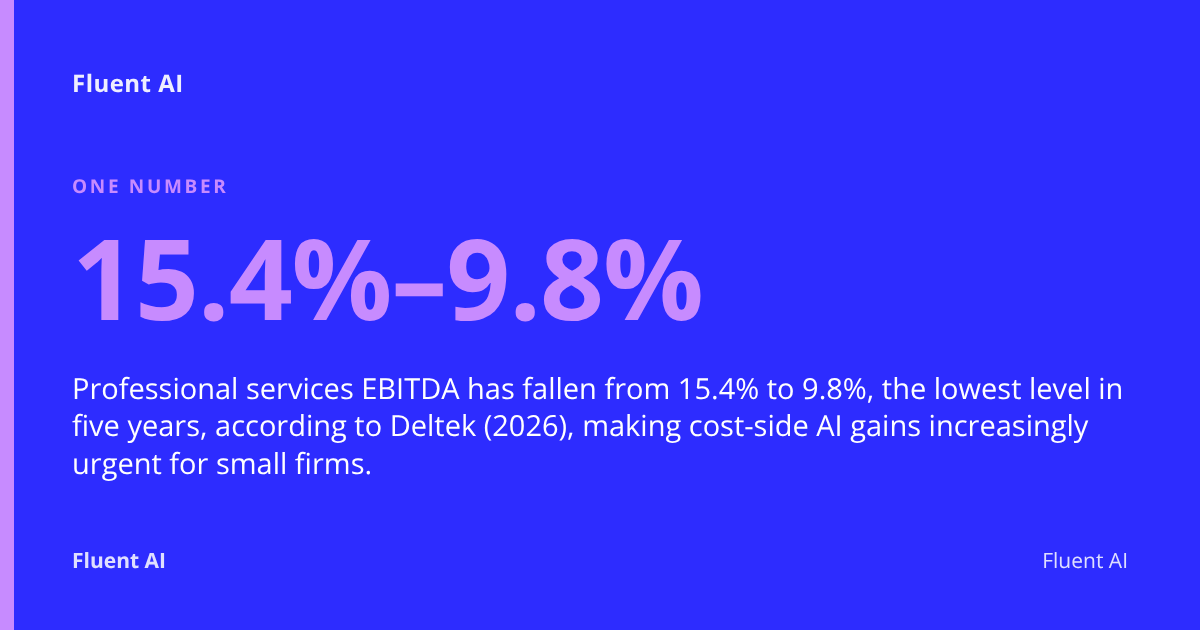
- Professional services EBITDA has fallen from 15.4% to 9.8%, the lowest level in five years, according to Deltek (2026), making cost-side AI gains increasingly urgent for small firms.
- Firms applying AI across predictive planning and client delivery achieve 6-8% margin improvement, compared with under 2% for firms using AI for automation alone, according to SPI Research / Unit4 (2026).
- AI workflow automation recovers 15 to 25 hours of productive time per staff member each week, raising billable utilisation by 12 to 18 percentage points, according to OS for your Business (2026).
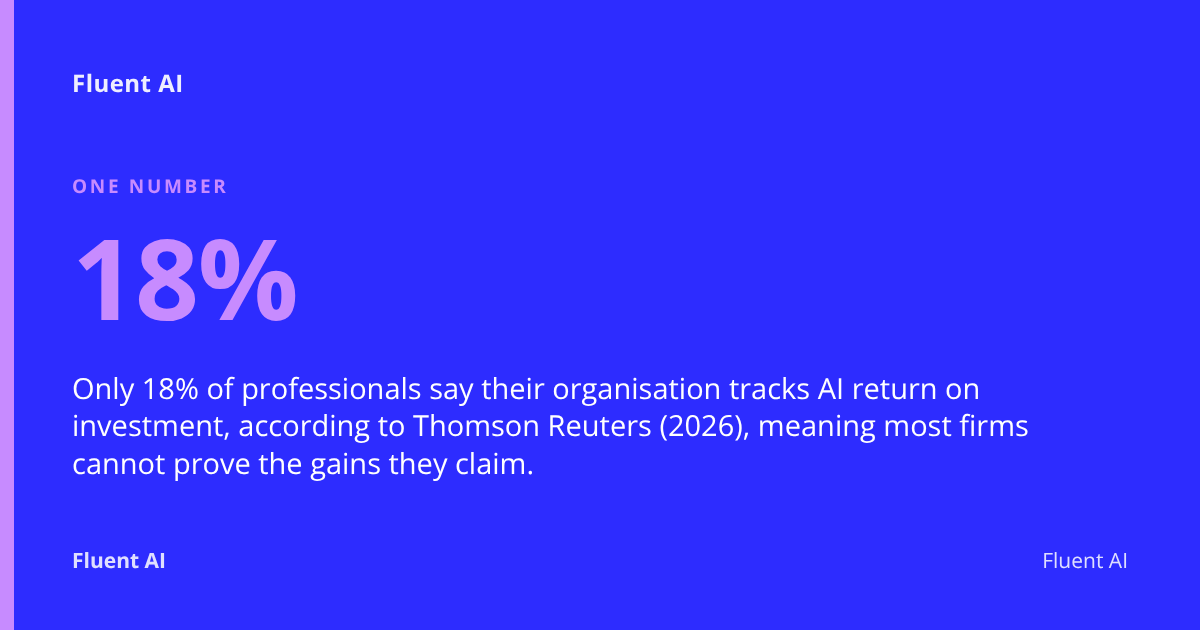
- Only 18% of professionals say their organisation tracks AI return on investment, according to Thomson Reuters (2026), meaning most firms cannot prove the gains they claim.
- Micro-businesses in the EU trail large enterprises by around 18 months in AI adoption, with adoption rates of roughly 24% against 44% for firms with 250+ staff, according to GOV.UK (2026).
What Are the Main Cost Levers AI Can Influence in a Small Professional Services Firm?
Cost levers are the specific points in a firm's finances where a change in practice directly moves the profit figure, and in a small accountancy, solicitors' practice or consultancy these are overwhelmingly billable hours, overhead spend, and write-offs. Billable hours are the time a fee-earner spends on chargeable client work, measured against total available hours — a ratio accountants call utilisation. Write-offs are time or disbursements a firm cannot bill the client for, often because work took longer than quoted or because a partner judges the time unrecoverable.
Overheads cover the fixed costs of running the practice: office rent, software licences, support staff salaries and professional indemnity insurance. AI's clearest effect is on utilisation. Professional services firms implementing AI workflow automation recover 15 to 25 hours of productive time per week per staff member, raising billable utilisation by 12 to 18 percentage points, according to OS for your Business (2026).
That recovered time either converts into more chargeable work or shrinks the hours a firm must bill at a loss to finish a fixed-fee job. The effect compounds with maturity. Firms with over 60% AI proficiency report EBITDA above 23%, the highest across all maturity levels, and those higher-performing firms also report 12% higher consultant day rates ($1,144 versus $1,024) and 9% higher project margins (35.8% versus 32.9%), according to sa.global (2026).
Firms focused purely on automating admin, rather than embedding AI in planning and delivery, see far smaller gains: less than 2% margin improvement, against 6-8% for firms applying AI to predictive planning and client delivery, according to SPI Research / Unit4 (2026). The lever that matters most is not the tool itself but where in the workflow it is applied.
Which Specific Tasks Can AI Realistically Automate for Accountants, Solicitors and Consultancies?
Task automation in professional services means using AI to draft, summarise, extract or organise work that a fee-earner previously did manually, leaving a human to review and approve the output. For a small accountancy practice in Tunbridge Wells or a solicitors' firm in Guildford, the realistic candidates are narrower than the marketing suggests.
- Document review and summarisation — AI can scan contracts, leases or financial statements and flag clauses or anomalies for a solicitor or auditor to check, rather than replacing the review itself.
- First-draft letters, reports and emails — AI generates a starting draft from a brief or template, which a fee-earner edits rather than writes from scratch.
- Research and case-law or standard lookup — AI tools can surface relevant precedents, HMRC guidance or accounting standards, cutting the time spent searching before analysis begins.
- Time recording and narrative generation — AI can auto-populate timesheets from calendar entries, emails and documents worked on, reducing the admin that eats into evenings.
- Meeting notes and action points — AI transcribes client calls and drafts follow-up actions, freeing partners from manual note-taking.
- Data entry and reconciliation — bookkeeping and invoice-matching tasks that previously sat with a junior can be substantially automated, with exceptions flagged for review.
The productivity effect is measurable at the sector level: 86.6% of firms report that AI has increased productivity and efficiency, up from 71.5% the year before, according to SPI Research (2026). Fluent AI's own work with small firms starts by mapping exactly which of these tasks consume the most hours before recommending any tool, through its AI Readiness Assessment.
What Does AI Implementation Typically Cost a Small UK Firm, and What Return Can Be Expected?
AI implementation cost is the combined spend on software licences, setup work and staff training needed to get AI tools reliably embedded in a firm's existing systems, rather than the headline subscription price of a single tool. For a small UK professional services firm, the realistic range spans a few hundred pounds a month for off-the-shelf tools through to several thousand pounds for a structured assessment and build.
An Assessment Only engagement costs £999 as a one-off, an Assessment plus Implementation costs £3,999 as a one-off, and Ongoing Support costs £899 per month. These figures give a small firm a concrete anchor against which to judge any other quote.
| Approach | Typical cost | What it covers |
|---|---|---|
| Off-the-shelf AI subscription (e.g. drafting or transcription tool) | £20-£80 per user/month | Single-task automation, no workflow integration |
| AI Readiness Assessment only | £999 one-off | Workflow audit and plain-English recommendations |
| Assessment + Implementation | £3,999 one-off | Audit, tool setup, workflow integration, team training |
| Ongoing Support | £899 per month | Continued troubleshooting as tools and needs change |
Return on investment depends on whether gains are actually tracked, and this is where most firms fall short. Only 18% of professionals say their organisation tracks AI return on investment, and a further 40% do not know whether it is measured at all, according to Thomson Reuters (2026). A firm that cannot answer "did this pay for itself?" is flying blind regardless of how much it spent.
How Long Does Implementation Take Before a Firm Sees Measurable Profitability Gains?
Implementation timescale is the period between first deciding to adopt AI and the point at which a firm can point to a measurable change in utilisation, write-offs or margin. For a small professional services firm with no in-house IT team, a realistic range is four to twelve weeks for initial setup, with profitability effects visible within one to two further billing cycles.
Fluent AI's typical project runs four to six weeks from initial call to a working, trained-up team, with the readiness assessment itself taking about a week. That timeline reflects a firm layering AI into tools it already uses — email, spreadsheets, calendars and existing practice-management software — rather than migrating to an entirely new platform, which is the approach Fluent AI's Workflow Integration service is built around.
Firms that skip the assessment stage and buy a tool outright often take longer to see any benefit, because nobody has mapped which workflow the tool should sit inside. The wider market reflects a maturity gap that small firms are working against. In the EU, enterprises with 250 or more employees have AI adoption rates of 44%, while micro-businesses sit around 24%, roughly 18 months behind large firms in AI adoption, according to GOV.UK's AI Adoption Plan (2026). A small firm that starts now is closing that gap rather than falling further behind it.
What Data Protection and Confidentiality Obligations Apply Before Using AI on Client Work?
UK GDPR — the United Kingdom General Data Protection Regulation, which governs how personal data is collected, stored and processed — applies in full to any client data a firm feeds into an AI tool. The Information Commissioner's Office regulates compliance and expects firms to have a lawful basis for processing before client information touches any third-party AI system.
Solicitors carry an additional duty of legal professional privilege, the protection that prevents confidential communications between a lawyer and client from being disclosed, which means client documents should never be uploaded to a public or unvetted AI tool. Accountants registered with the Institute of Chartered Accountants in England and Wales (ICAEW) and solicitors regulated by the Solicitors Regulation Authority (SRA) both carry professional confidentiality obligations that sit above and beyond UK GDPR.
Before using any AI tool on client data, a firm should check:
- Where the vendor stores and processes data, and whether servers sit inside the UK or EU
- Whether client data is used to train the AI model itself, which most firms should refuse
- Whether the vendor holds a data processing agreement compliant with UK GDPR
- Whether the tool has an enterprise or business tier with stronger data controls than its free consumer version
Fluent AI builds data-handling checks into every AI Readiness Assessment, because a tool that looks efficient on day one can create a serious confidentiality breach on day ninety if client data is routed through the wrong service tier.
AI Versus Hiring Junior Staff or Outsourcing: Which Improves Margins Faster?
Comparing AI adoption against hiring a junior or outsourcing work means weighing a fixed, recurring software cost against a variable, headcount-linked cost that carries recruitment, training and management overhead. A junior fee-earner in the South East typically costs a firm £28,000-£35,000 a year in salary alone, before National Insurance, pension contributions, desk space and the partner time spent training and reviewing their work.
AI does not replace the judgement a qualified professional brings, but it can absorb the repetitive first-draft and research work that used to justify hiring a junior in the first place.
| Factor | Additional junior hire | Outsourcing | AI tools (assessed and integrated) |
|---|---|---|---|
| Typical annual cost | £28,000-£35,000+ | Variable, per project | £899/month ongoing support, or £3,999 one-off build |
| Ramp-up time | 3-6 months to full productivity | Immediate, but quality varies | 4-6 weeks to embed |
| Scales up/down easily | No — notice periods apply | Partially | Yes |
| Confidentiality control | High, direct oversight | Lower, third party involved | Depends entirely on vendor and setup |
| Builds firm capability | Yes, long-term asset | No | Yes, if paired with training |
The honest answer is that these are not always alternatives. A firm growing quickly may still need both a junior and better tools. Where AI wins decisively is in absorbing fluctuating, repetitive demand without the fixed cost of a salary — and in freeing existing staff, rather than adding more of them, which matters given the sector's current margin pressure. Professional services firms report a steep decline in EBITDA from 15.4% to 9.8%, the lowest level in the past five years, according to Deltek (2026).
Who Should Be Responsible for Selecting and Monitoring AI Tools in a Small Firm?
Ownership of AI adoption should sit with a single named partner or senior manager, not be left to whichever junior happens to be interested in the technology. In a firm of under 20 people, that person does not need to be technical — they need the authority to approve spend, the oversight to check client confidentiality is respected, and the accountability to track whether tools are actually saving time.
Common structures that work for small firms include:
- A managing partner who owns the decision but delegates day-to-day testing to a nominated team member
- A practice manager who runs the assessment process and reports results back to the partnership
- An external consultancy brought in specifically to run the audit, implementation and training, reporting findings in plain English rather than technical jargon
This last model is why Fluent AI, run by Charlie and Lauren Dawkins from the South East, exists: many small firms know AI could help but have nobody with the time or confidence to lead the project internally. Fluent AI's five-step process — a 15-minute call, an audit, a plain-English plan, the build, and ongoing support — gives a firm an external owner for the project without requiring any technical knowledge from staff; if you can use email and spreadsheets, you already have the skills needed to work with the output.
Your AI Profitability Checklist
- Map which tasks (drafting, research, time recording, document review) currently consume the most billable hours
- Request a plain-English AI readiness assessment before buying any tool
- Confirm vendor data storage location and UK GDPR compliance before uploading any client document
- Check whether the tool's free tier uses your data for model training, and avoid it if so
- Set a four-to-six-week pilot window and define what "success" looks like in hours saved or write-offs reduced
- Nominate one named person to own tool selection, rollout and ongoing monitoring
- Track utilisation and write-off figures before and after rollout so ROI is measurable, not assumed
- Review progress at 90 days and decide whether to extend, adjust or expand AI use
FAQ
Can AI really improve profitability in a small professional services firm?
Yes — firms applying AI across planning and client delivery report 6-8% margin improvement, compared with under 2% for firms using it only for basic automation, according to SPI Research / Unit4 (2026). The gain depends heavily on where in the firm's workflow AI is applied.
How much should a small UK firm budget for AI tools?
Budgets vary widely, from roughly £20-£80 per user per month for a single off-the-shelf tool to several thousand pounds for a structured assessment and build. Fluent AI, for example, prices an Assessment Only engagement at £999 one-off and an Assessment plus Implementation at £3,999 one-off, giving a concrete benchmark for comparison.
Is client data safe when using AI tools in a solicitors' or accountancy practice?
Client data is only safe if the firm checks the vendor's data storage location, confirms it will not be used for model training, and ensures compliance with UK GDPR as regulated by the Information Commissioner's Office. Solicitors additionally carry a duty of legal professional privilege, which free consumer-grade AI tools are not built to protect.
Will AI replace junior staff in a small professional services firm?
AI is not designed to replace staff but to absorb the repetitive first-draft, research and admin tasks that previously filled much of a junior's day. Fluent AI's approach is explicitly to automate repetitive tasks so existing teams can focus on judgement-based work, rather than to reduce headcount.
How long does it take to see profitability gains from AI adoption?
Most small firms see initial setup completed within four to six weeks and measurable effects on utilisation or write-offs within one to two further billing cycles. Fluent AI's typical project timeline runs four to six weeks from the first call to a trained, working team.
What is the biggest mistake small firms make when adopting AI?
The most common mistake is buying a tool before mapping which workflow it should sit inside, which explains why only 18% of professionals say their organisation actually tracks AI return on investment, according to Thomson Reuters (2026). Without a baseline measurement, a firm cannot tell whether a tool is paying for itself.
Do regulators like the SRA or ICAEW have specific rules on AI use?
The Solicitors Regulation Authority and the Institute of Chartered Accountants in England and Wales do not ban AI use, but both bodies expect members to maintain the same confidentiality, competence and accuracy standards regardless of what tools are used to produce the work. Firms remain professionally and legally responsible for any AI-assisted output they put in front of a client.
Securing Profitability Gains with Fluent AI
Every lever covered in this article — recovered billable hours, reduced write-offs, safer client data handling — depends on the same starting point: knowing exactly which part of a firm's workflow is costing the most time before choosing a tool. That is the gap Fluent AI was built to close, working with small professional services firms across London, Kent, Surrey and Sussex who know AI could help but have never had the time to work out where to start.
Fluent AI's process begins with a free 15-minute call, described on its site as no pitch and no pressure, followed by an AI Readiness Assessment that typically takes about a week and ends with a plain-English report on what is actually worth automating. If the assessment finds AI will not genuinely save time or money, Fluent AI says so rather than selling a tool the firm does not need.
If your firm's margins are under pressure and you want a clear, honest view of where AI could help, book a free call with Fluent AI or complete the four-minute free AI audit to get a personalised readiness snapshot.
Not sure where AI fits in your business?
Book a free 15-minute call. No pitch, no pressure, just an honest conversation about whether we can help.
Book a Free Call Or take the free AI audit first →