Last updated: 25 October 2026
A commercial property agency can use AI to cut lease abstraction time, speed up valuations, automate rent reviews and handle first-line client queries, while keeping a RICS-regulated surveyor accountable for every output. Globally, 88% of commercial real estate investors and owners have started AI pilots, yet only 5% report achieving most of their programme goals — a gap that careful, staged adoption closes (JLL 2025 Global Real Estate Technology Survey, 2025).
Key Takeaways
- 88% of commercial real estate investors and owners have run AI pilots, but only 5% report achieving most of their AI programme goals, according to the JLL 2025 Global Real Estate Technology Survey.
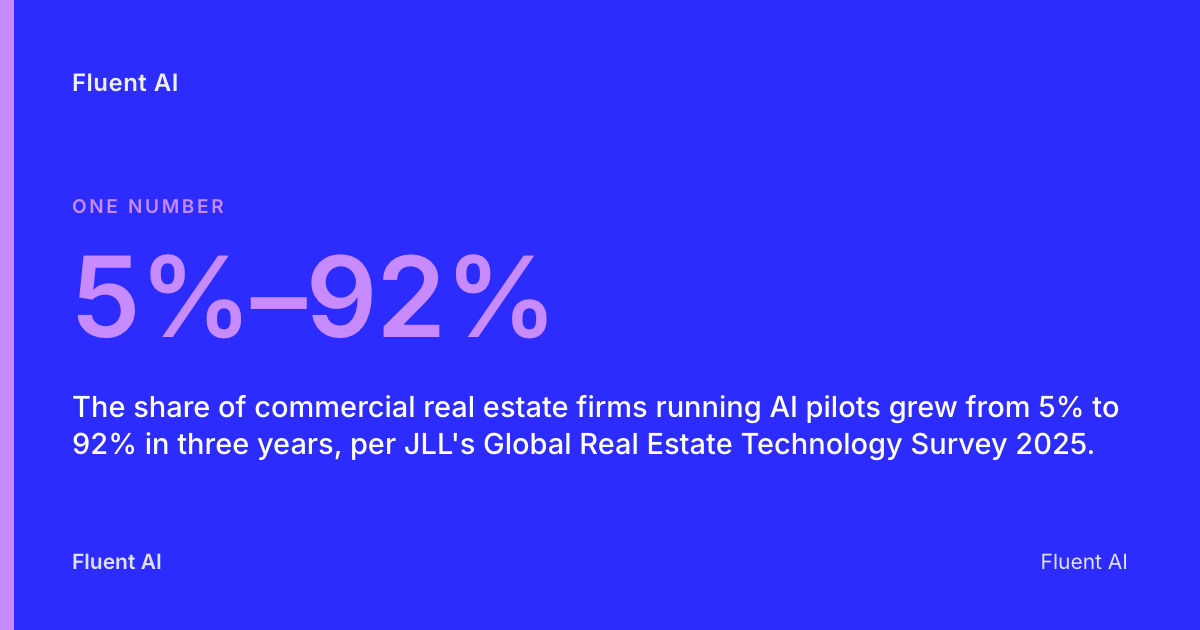
- The share of commercial real estate firms running AI pilots grew from 5% to 92% in three years, per JLL's Global Real Estate Technology Survey 2025.
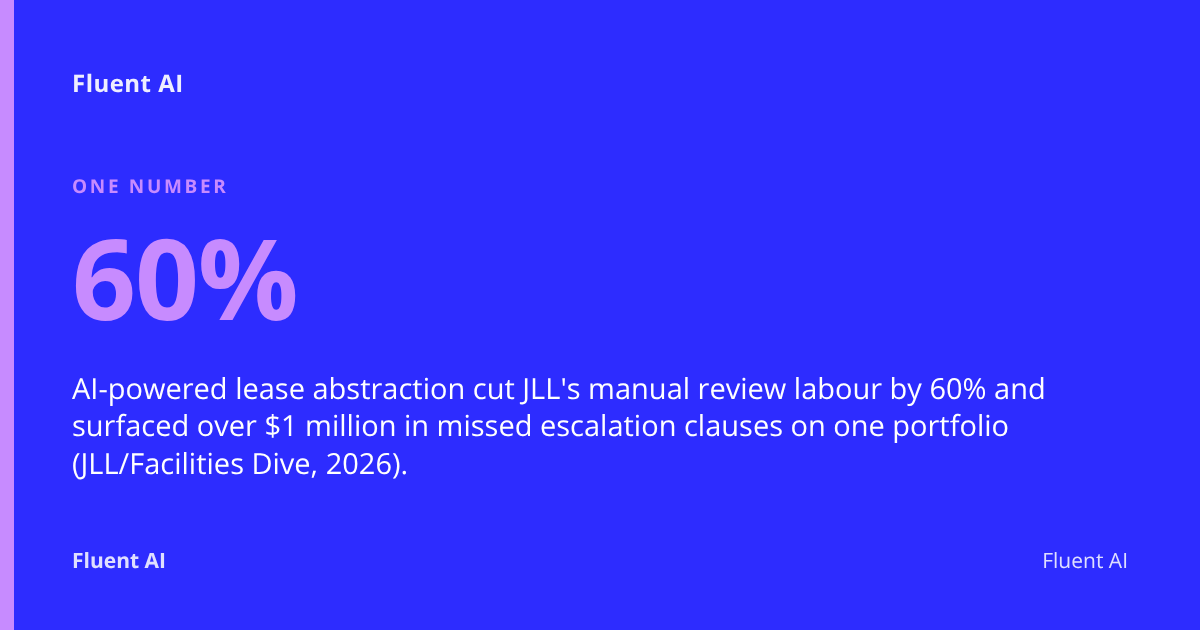
- AI-powered lease abstraction cut JLL's manual review labour by 60% and surfaced over $1 million in missed escalation clauses on one portfolio (JLL/Facilities Dive, 2026).
- CBRE reports that automated lease abstraction can save brokers up to 25% of their time (CBRE via Ascendix, 2026).
- A chartered surveyor remains personally accountable for any AI-assisted valuation under RICS's UK Commercial Real Estate Agency Professional Statement — AI cannot sign off a valuation itself.
What Is AI in a Commercial Property Agency Context?
AI in a commercial property agency is software that uses machine learning and natural language processing to handle tasks a human previously did manually — reading leases, drafting marketing copy, scoring leads, or answering routine tenant emails. It is not a replacement for a chartered surveyor's professional judgement; it is a layer that speeds up the repetitive work around that judgement.
Two terms get used loosely and are worth separating. Generative AI (tools like ChatGPT or Microsoft Copilot) produces text, summaries and drafts from a prompt. Agentic AI goes further — it can take multi-step actions across systems, such as pulling lease data, drafting a rent review letter, and updating a CRM record without a human triggering each step. McKinsey & Company describes this shift as moving from tools that assist a task to agents that run a workflow.
For a small or mid-sized UK agency — a typical independent firm covering a county or sub-region rather than a national portfolio — the realistic starting point is generative AI for drafting and summarising, with agentic workflows added once staff trust the outputs.
Where Can AI Be Applied Across Agency Operations?
Four areas of a commercial property agency's operations see the most practical AI use today: marketing and lead generation, lease and document management, valuations and market analysis, and client or tenant communication. Each has a different maturity level and a different risk profile.
Marketing and lead generation. AI can draft property particulars, generate social media listings, and score inbound enquiries by likelihood to convert. McKinsey's research (via Forbes) found that home builders using AI agents saw lead response times jump by more than 90%, because an agent can reply to an enquiry within minutes rather than hours.
Lease and document management. This is where the clearest, most-cited ROI sits. AI reads lease documents, extracts key dates, rent review clauses, and break options, and flags anomalies for a human to check.
Valuations and market analysis. AI tools can pull comparable transaction data, model rental growth scenarios, and draft the narrative sections of a valuation report — but the RICS Red Book valuation itself must still be signed by a qualified valuer.
Client and tenant communication. Chatbots and AI email assistants can handle first-line enquiries, viewing bookings, and routine rent or service charge questions, escalating anything complex to a named member of staff.
What AI Tools Do UK Commercial Agents Actually Use, and What Do They Cost?
UK commercial property agents are using a mix of general-purpose AI assistants and property-specific platforms, with costs ranging from free consumer tools to five- and six-figure enterprise contracts at firms like JLL and CBRE. Large agencies are building bespoke lease-abstraction AI in-house; smaller agencies are more likely to adopt off-the-shelf generative AI layered onto existing CRM and property management software.
| Tool category | Example use | Typical cost range (indicative) | Best suited to |
|---|---|---|---|
| General-purpose AI assistant (e.g. ChatGPT, Microsoft Copilot) | Drafting particulars, summarising emails, meeting notes | Free to roughly £15-£25 per user/month | Agencies of any size starting out |
| AI lease abstraction tools | Extracting dates, rent reviews, break clauses from leases | Mid-hundreds to low-thousands of pounds per month, scaling with document volume | Agencies managing multiple leases or portfolios |
| AI-enhanced CRM/property management software | Lead scoring, automated follow-ups, rent review tracking | Often bundled into existing software subscription as an add-on tier | Agencies already using a CRM or PMS |
| Chatbot/virtual assistant for enquiries | First-line website and email responses | Varies widely by provider and volume | Agencies with high enquiry volume |
| Bespoke workflow integration (e.g. Fluent AI) | AI built into a firm's existing email, spreadsheets and CRM | Project-based, from under £1,000 for an assessment | Small to mid-sized agencies wanting a tailored fit without new platforms |
How Much Does It Cost a Small or Mid-Sized Agency to Implement AI, and How Long Until ROI?
Implementing AI in a small to mid-sized commercial property agency typically involves three cost layers: an initial audit or readiness assessment, the build or integration work, and ongoing support as tools and staff needs evolve. There is no single UK-wide published benchmark for agency-specific AI spend, so agencies should treat vendor quotes as the primary source and budget in stages rather than committing to a single large contract upfront.
As a worked illustration of the typical shape of this spend (not a universal benchmark), published pricing for small businesses runs from £999 for an assessment-only engagement, up to £3,999 for an assessment plus full implementation, with £899 per month for ongoing support thereafter. Fluent AI's typical project timeline runs from the initial 15-minute call through a roughly one-week assessment, to a working system in 4 to 6 weeks.
On return timing, the honest answer is that it varies by task. Document-heavy, repetitive tasks — lease abstraction, rent review letters, standard enquiry responses — tend to show time savings within weeks, because the task was already well-defined before AI touched it. More judgement-heavy tasks, like valuation narrative drafting or market positioning, take longer to trust and refine.
At the large end of the market, the scale of potential value is substantial: McKinsey Global Institute estimates generative AI could create between $110 billion and $180 billion in value for the real estate industry globally, and a separate McKinsey Global Institute analysis puts the wider automation opportunity across real estate, construction and development at roughly $430 billion to $550 billion annually. These figures describe the global industry, not a single UK agency's budget — but they signal that the direction of travel is well-established, not speculative.
A smaller agency should not expect JLL-scale savings on day one. CBRE's data shows automated lease abstraction can save up to 25% of a broker's time (CBRE via Ascendix, 2026) — a more realistic reference point for a single-office firm than headline portfolio-wide figures.
What Data Protection and RICS Obligations Apply When an Agency Uses AI?
UK commercial property agencies processing client or tenant data through AI tools remain fully bound by the UK GDPR and the Data Protection Act 2018, regardless of which AI vendor is used. The Information Commissioner's Office (ICO) is the UK regulator responsible for enforcing these rules, and it treats a business as the data controller even when an AI tool is the data processor.
Before feeding tenant, landlord or prospective buyer data into any AI tool, an agency should check:
- Where the data is processed and stored — some AI tools process data outside the UK/EEA, which triggers additional safeguards under UK GDPR.
- Whether the vendor trains its models on your data — many enterprise AI contracts now include a no-training clause; consumer-tier tools often do not.
- Whether a Data Processing Agreement (DPA) is in place with the AI vendor, as required under UK GDPR Article 28.
- Whether a Data Protection Impact Assessment (DPIA) is needed — likely if the AI tool makes automated decisions affecting individuals, such as tenant creditworthiness scoring.
On the professional standards side, the Royal Institution of Chartered Surveyors (RICS) has not published AI-specific rules that override its existing framework. The RICS UK Commercial Real Estate Agency Professional Statement still requires a named, qualified individual to take responsibility for advice given to a client — an AI output does not change who is accountable. A chartered surveyor using AI to draft a valuation report is still personally and professionally liable for its accuracy under RICS Rules of Conduct.
Who Should Oversee AI Adoption Inside the Agency?
Responsibility for AI adoption inside a commercial property agency should sit with a named senior individual — typically a partner, director, or head of operations — who reports progress to the rest of the leadership team, rather than being left to whichever member of staff is most comfortable with technology. This avoids the common failure mode where a junior enthusiast introduces a tool informally and nobody checks its outputs, data handling, or RICS compliance implications.
That individual's responsibilities should include:
- Running or commissioning an AI readiness audit before any tool is purchased, to identify which workflows genuinely benefit from automation.
- Owning the data protection relationship with any AI vendor, including DPAs and GDPR compliance checks.
- Setting a review cadence — monthly in the first quarter, then quarterly — to check AI outputs against actual outcomes.
- Coordinating staff training so the whole team, not just early adopters, understands what the tool does and does not do.
This is precisely the gap Fluent AI's AI Readiness Assessment is built to close for smaller agencies that do not have a dedicated IT or innovation function: an external audit of existing workflows, with a plain-English report on what is worth automating and what is not, removes the guesswork from who should be driving adoption and what "good" looks like.
What Mistakes Do Agencies Make When First Introducing AI?
Agencies most commonly fail at AI adoption by piloting too many tools at once, skipping staff training, and trusting AI outputs without a human check — the same pattern that produces the 88% pilot rate but only 5% success rate found across the wider commercial real estate sector (JLL 2025 Global Real Estate Technology Survey).
The recurring mistakes are:
- Buying a platform before mapping the workflow. Software is purchased because a competitor uses it, not because an internal audit identified a genuine time-waster.
- No human-in-the-loop check on client-facing content. Draft emails, valuation narratives or lease summaries go out unreviewed, risking factual errors reaching a client.
- Treating AI as a one-off project rather than an ongoing capability. Tools and models change; without ongoing support, confidence and usage drop off within months.
- Ignoring data protection at the procurement stage. GDPR compliance gets treated as an afterthought rather than a condition of vendor selection.
- Under-training staff. Giving a team access to a tool without plain-English training leads to inconsistent, low-quality use — or staff quietly avoiding it altogether.
McKinsey partner Alex Wolkomir frames the underlying issue well: "You need to focus on designing the operating models, not the AI models that live within them." The technology is rarely the limiting factor — the surrounding process and training usually are.
In-House Build vs Outsourced AI Integration: Which Suits a Smaller Agency?
A commercial property agency generally has two paths into AI: building capability in-house with an IT lead or tech-savvy partner, or bringing in an external consultancy to audit, integrate and train. The right choice depends on existing resource, not ambition.
| Factor | In-house build | Outsourced integration |
|---|---|---|
| Upfront cost | Lower cash cost, higher time cost from existing staff | Fixed project cost, e.g. an assessment from £999 |
| Speed to live system | Variable — depends on staff bandwidth alongside day jobs | Structured timeline, typically 4-6 weeks for a full build |
| GDPR and RICS risk oversight | Relies on staff knowledge of compliance requirements | External specialist can flag risks staff may miss |
| Staff training | Informal, often inconsistent across the team | Structured, plain-English sessions for the whole team |
| Ongoing support | Depends on staff availability as priorities shift | Dedicated support arrangement, e.g. a monthly retainer |
Agencies with an in-house IT function and spare capacity may reasonably build internally. Agencies without that capacity — the majority of single-office and regional firms — tend to get a working system live faster, with fewer false starts, by using a structured external process.
Your AI Adoption Checklist for a Commercial Property Agency
- Map existing workflows before buying any software, to identify genuine time-wasters rather than copying a competitor's tool choice.
- Confirm where any AI vendor stores and processes data, and whether this complies with UK GDPR and the Data Protection Act 2018.
- Put a Data Processing Agreement in place with every AI vendor handling client or tenant data.
- Name one senior individual to own AI adoption, data protection compliance, and ongoing review.
- Keep a qualified surveyor in the loop on every AI-assisted valuation, in line with RICS's professional statement requirements.
- Test any client-facing chatbot or email assistant on a sample of real enquiries before full rollout, checking tone, accuracy and escalation triggers.
- Train the whole team in plain English, not just the early adopters.
- Review AI performance monthly in the first quarter, then quarterly, against time saved and client satisfaction.
FAQ
Can AI replace a chartered surveyor's valuation under RICS rules?
No. AI can assist with data gathering, comparable analysis and report drafting, but a qualified valuer must still sign off a RICS Red Book valuation and remains personally accountable under the RICS UK Commercial Real Estate Agency Professional Statement.
Is it GDPR-compliant to put tenant or landlord data into tools like ChatGPT?
It depends on the tool's data handling terms and whether a Data Processing Agreement is in place. Consumer-tier AI tools often process data without the safeguards UK GDPR requires for client data, so agencies should check enterprise-tier options with clear no-training and UK/EEA data residency terms before entering any personal data.
How long does it take a small agency to see results from AI?
Document-heavy tasks like lease abstraction or drafting rent review letters tend to show time savings within the first few weeks of use, because the underlying task is already well-defined. Judgement-heavy tasks, such as valuation narratives, typically take longer as staff build trust in outputs. Fluent AI's typical project timeline, from first call to a working system, runs 4 to 6 weeks.
What is the single biggest risk of using AI for client communication?
The biggest risk is an unreviewed AI response reaching a client with a factual error — an incorrect rent figure, an outdated lease term, or a misleading commitment. Any chatbot or AI email assistant should be tested against real past enquiries and given a clear escalation path to a human before full deployment.
Do I need a dedicated AI manager to adopt these tools?
Not necessarily a full-time role, but a named senior individual should own AI adoption, data protection compliance and staff training rather than leaving it informal. In a small agency this is often a partner or operations lead working with external support rather than a new hire.
What AI use case gives the fastest, most measurable ROI for a commercial agency?
Lease abstraction and document review currently show the clearest returns. CBRE's data indicates automated lease abstraction can save up to 25% of a broker's time, and JLL's AI lease abstraction work reduced manual review labour by 60% on one deployment (JLL/Facilities Dive, 2026).
How do I measure whether AI is actually improving efficiency?
Track time spent on the specific task before and after AI adoption, alongside client satisfaction and error rates on AI-assisted outputs. Review these figures monthly for the first quarter, then quarterly, against the goals set during the initial readiness assessment, rather than judging AI on anecdote alone.
Running Your Agency's AI Adoption with Fluent AI
Every challenge covered above — knowing where to start, protecting client data, training staff without disrupting fee-earning work, and proving the tool is actually worth the subscription — is exactly what Fluent AI helps small and mid-sized businesses in the South East work through. Rather than asking a commercial property agency to learn a new platform, Fluent AI builds AI into the email, spreadsheets, CRM and calendar tools the team already uses, so lease summaries, enquiry responses and rent review reminders fit into existing habits rather than fighting them.
Fluent AI's process starts with a free 15-minute call and an AI Readiness Assessment — an audit of current workflows with a plain-English report on what's genuinely worth automating in your agency, and what isn't. If the audit finds AI won't save your agency meaningful time or money, Fluent AI says so rather than pushing a sale.
For a commercial property agency based in London, Kent, Surrey or Sussex wondering where to begin, the practical next step is the free 15-minute call or the four-minute online AI audit at fluent-ai.co.uk — no pitch, no pressure, just a clear view of what's worth doing first.
Not sure where AI fits in your business?
Book a free 15-minute call. No pitch, no pressure, just an honest conversation about whether we can help.
Book a Free Call Or take the free AI audit first →