Last updated: 26 October 2026
ChatGPT is safe for UK business use only when deployed with the right plan, policy and staff training — not by default. Free and Plus accounts may retain and train on your data, while ChatGPT Enterprise now offers UK data residency at rest (from October 2026). Without a Data Protection Impact Assessment and a clear acceptable-use policy, businesses risk breaching UK GDPR.
Key Takeaways
- ChatGPT Enterprise introduced UK data residency in October 2025, covering storage at rest, though inference still runs in Europe, the US or the UAE, according to OpenAI Help Center, cited by The AI Consultancy (2026).
- 11% of data employees pasted into ChatGPT was classified as confidential, based on a Cyberhaven (2023) analysis of 1.6 million knowledge workers.
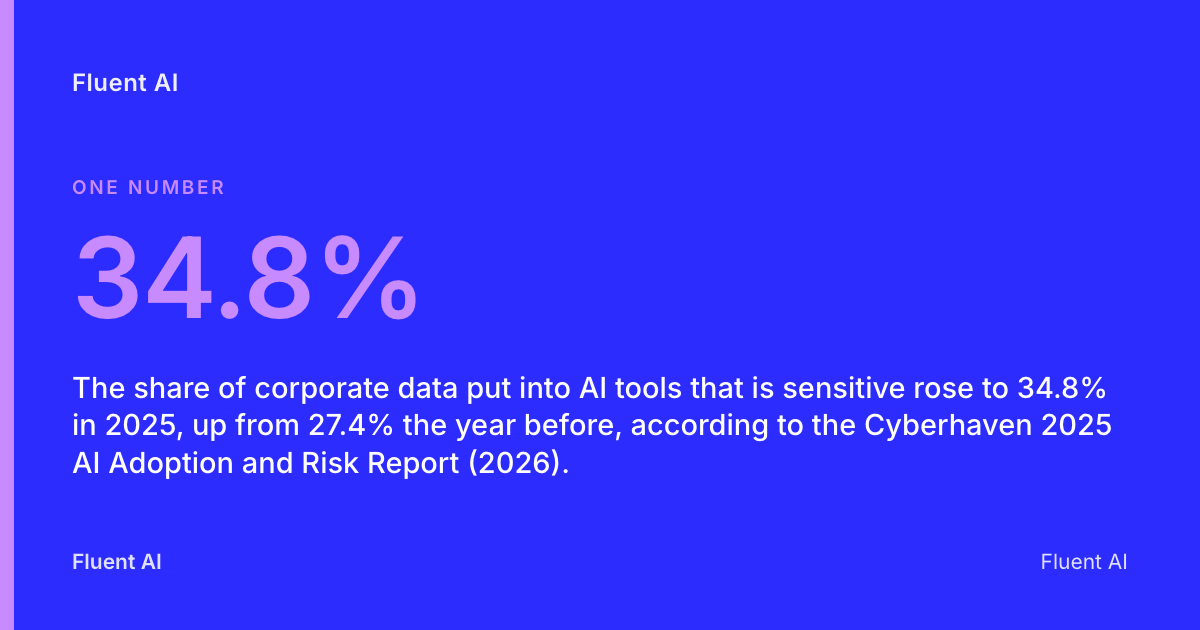
- The share of corporate data put into AI tools that is sensitive rose to 34.8% in 2025, up from 27.4% the year before, according to the Cyberhaven 2025 AI Adoption and Risk Report (2026).
- Samsung Semiconductor employees leaked confidential source code and meeting data to ChatGPT three times in one month in 2023, prompting an internal ban, as reported by Gizmodo (2023).
- Fluent AI's AI Readiness Assessment audits a business's workflows and reports plainly what is worth automating — a practical first step before any ChatGPT rollout.
What data protection risks does ChatGPT pose under UK GDPR?
UK GDPR is the United Kingdom General Data Protection Regulation, the retained EU law that governs how organisations collect, store and process personal data after Brexit, working alongside the Data Protection Act 2018 — the UK statute that sets out specific exemptions and enforcement powers. The core risk with ChatGPT is that any personal data typed into a prompt — a customer's name, a patient record, an employee's salary — becomes processed data under this law, and the business inputting it is the data controller responsible for that processing.
The Information Commissioner's Office (ICO) runs an ongoing consultation series on generative AI, confirming that UK GDPR principles apply in full to tools like ChatGPT. This includes lawfulness, purpose limitation and data minimisation — meaning a business must have a legal basis before feeding customer data into a prompt, and cannot simply assume consent exists.
A further risk is international transfer. OpenAI processes most ChatGPT data in the United States, which means UK businesses typically rely on a transfer mechanism such as the International Data Transfer Addendum (IDTA) or Standard Contractual Clauses (SCCs) to keep that transfer lawful. The National Cyber Security Centre (NCSC) has also flagged that prompts submitted to large language models may be retained and could, in principle, resurface in future outputs — a risk NCSC technical directors describe directly.
Does OpenAI train on your ChatGPT data, and can you opt out?
OpenAI's data training policy depends entirely on which ChatGPT product a business uses, and opting out is possible on some tiers but not guaranteed on all. On ChatGPT Free and ChatGPT Plus, OpenAI may use conversation content to improve its models unless the user manually disables "Improve the model for everyone" in settings — a setting many employees never find or think to change.
By contrast, OpenAI's Enterprise Privacy page states that ChatGPT Business, Team and Enterprise customers are not used for model training by default, and that a Data Processing Agreement (DPA) covers these plans. This is the single biggest distinction between consumer and business-grade ChatGPT accounts.
The practical risk is that staff often sign up for a personal ChatGPT account using a work email, unaware that their default settings differ from the protections a properly licensed company account would carry. This gap is exactly why Fluent AI's Workflow Integration service starts by mapping which account types staff are actually using, not assuming the business has already standardised on one.
What is the difference between ChatGPT Free, Team, and Enterprise for business safety?
ChatGPT Free, Team and Enterprise are three distinct tiers of OpenAI's product, each carrying a different level of data protection, administrative control and contractual backing. ChatGPT Free is a consumer tool with no admin console, no guaranteed opt-out from training, and no formal DPA — unsuitable for handling client or employee data.
ChatGPT Team adds a signed Data Processing Agreement, excludes business content from model training by default, and gives an admin basic user management. ChatGPT Enterprise goes further still, adding enterprise-grade security certifications, unlimited higher-speed access, and, as of October 2025, UK data residency for storage at rest — though OpenAI still runs inference (the actual processing step that generates a response) only in the EEA/Switzerland, the US, or the UAE, per the OpenAI Help Center, cited by The AI Consultancy (2026).
| Feature | ChatGPT Free | ChatGPT Team | ChatGPT Enterprise |
|---|---|---|---|
| Data used for training | Yes, unless manually opted out | No, by default | No, by default |
| Formal Data Processing Agreement | No | Yes | Yes |
| Admin console / user management | No | Basic | Advanced |
| UK data residency (storage at rest) | No | No | Yes (from October 2026) |
| Suitable for client/customer data | Not recommended | With policy controls | Best suited, with DPIA |
For most small and medium-sized UK businesses, ChatGPT Team represents the realistic minimum for any work involving client information, with Enterprise reserved for organisations handling higher volumes of regulated or sensitive data.
Who is legally responsible when an employee shares client data with ChatGPT?
The employer, not the individual employee, is almost always the data controller under UK GDPR and therefore carries the legal liability when confidential client data ends up in ChatGPT. This matters because the ICO holds organisations accountable for the actions of their staff when those actions happen within the course of employment, regardless of whether a formal AI policy existed.
This is not a theoretical risk. Cyberhaven's (2023) analysis found that 3.1% of workers at companies using its security product had pasted confidential company data into ChatGPT, with some 100,000-employee organisations recording as many as 7,999 paste attempts in a single day in 2023. Samsung Semiconductor experienced three separate confidential data leaks — including source code and equipment measurement data — in one month in 2023, which led the company to ban generative AI tools internally, according to Gizmodo (2023).
An employee acting without authorisation does not remove the employer's liability; it usually increases it, because it demonstrates a failure of policy and training. This is why Fluent AI treats Team Training as inseparable from any AI rollout — plain-English sessions that make clear, before a single prompt is typed, what data can and cannot go into ChatGPT.
How should a UK business carry out a Data Protection Impact Assessment before using ChatGPT?
A Data Protection Impact Assessment (DPIA) is a structured risk assessment required under UK GDPR whenever a new technology is likely to result in high risk to individuals' data rights. Rolling out ChatGPT across a team handling customer or employee records typically meets this threshold, making a DPIA a practical necessity rather than an optional extra.
The ICO's generative AI guidance sets out that organisations must consider individual rights — including the right to be informed and the right of access — when deploying tools that process personal data at scale. A practical DPIA for ChatGPT should work through these steps:
- Map the data flows — identify every point where staff might input customer, employee or supplier information.
- Identify the legal basis — confirm whether consent, contract or legitimate interest justifies each use case.
- Assess the ChatGPT tier in use — Free, Team or Enterprise, each carrying different risk levels as outlined above.
- Document transfer safeguards — confirm whether an IDTA or SCCs cover the transfer of data to OpenAI's US infrastructure.
- Set mitigations — restrict account types, disable training opt-ins, and define retention limits.
- Review and sign off — a named data protection lead should approve the DPIA before go-live.
Fluent AI's AI Readiness Assessment maps a business's existing workflows first, which gives the DPIA process a concrete, business-specific starting point rather than a generic template.
What should employees never type into ChatGPT at work?
Employees should never input personally identifiable customer information, financial account details, health records, unpublished financial results, trade secrets or login credentials into ChatGPT without organisational authorisation and a documented legal basis. This single rule prevents the majority of real-world incidents seen so far.
The risk is growing, not shrinking. Cyberhaven's 2025 AI Adoption and Risk Report (2026) found that the proportion of corporate data employees put into AI tools classified as sensitive rose to 34.8% in 2025, up from 27.4% the year before and just 10.7% two years earlier. Earlier data from Cyberhaven (2023) had already shown 11% of pasted content was confidential, based on 1.6 million knowledge workers.
A clear "never input" list for UK staff should cover:
- Customer names paired with financial, health or contact details
- Employee records, including payroll, disciplinary or HR case notes
- Contract terms, pricing models or supplier agreements under NDA
- Source code, product designs or pre-launch material
- Passwords, API keys or internal system credentials
- Anything a regulator — such as the FCA, SRA or CQC — would classify as regulated client information
How does ChatGPT use affect compliance in finance, healthcare, and legal services?
Regulated UK sectors face compliance obligations layered on top of UK GDPR, meaning ChatGPT use can breach sector rules even when general data protection law is technically satisfied. In financial services, firms regulated by the Financial Conduct Authority (FCA) must maintain records and client confidentiality standards that a consumer-grade ChatGPT account cannot guarantee, given OpenAI's US-based processing and variable retention policies.
In legal services, solicitors regulated by the Solicitors Regulation Authority (SRA) owe clients a duty of confidentiality that predates — and sits independently of — data protection law; pasting case details into ChatGPT Free risks breaching that duty regardless of GDPR compliance. In healthcare, any tool touching patient data must be assessed against NHS data security standards and, where relevant, Care Quality Commission (CQC) expectations, since health data is classed as "special category data" under UK GDPR, carrying stricter processing conditions.
The practical answer for regulated firms is to treat ChatGPT Free and Plus as unsuitable for any client-identifiable work, and to require ChatGPT Team or Enterprise, paired with a sector-specific policy, before any regulated information touches the tool.
What mistakes do UK businesses make when first introducing ChatGPT to staff?
The most common mistake is rolling ChatGPT out informally — staff discover it themselves, sign up with work email addresses on free accounts, and start using it for real client work before any policy exists. This happens faster than most management teams expect, given that ChatGPT's UK traffic already represents roughly 3.3%–3.48% of its global visits, according to Similarweb / Master of Code (2026), reflecting how embedded the tool already is in UK working life.
A second common mistake is treating ChatGPT as a single, uniform tool rather than recognising that Free, Team and Enterprise carry materially different protections. A third mistake is skipping training altogether, assuming staff will intuitively understand data boundaries — an assumption Cyberhaven's figures above repeatedly disprove.
Fluent AI sees this pattern often with small businesses across London, Kent, Surrey and Sussex: enthusiasm for AI arrives well before any governance does. Fluent AI's approach reverses that order — assessment and policy first, tool adoption second — specifically to close this gap before it becomes an incident.
Your ChatGPT business safety checklist
- Confirm which ChatGPT tier staff are actually using, and migrate any personal Free accounts to a licensed Team or Enterprise plan.
- Switch off "Improve the model for everyone" on any account that defaults to training on inputs.
- Complete a Data Protection Impact Assessment before any team-wide rollout.
- Write a one-page "never input" list covering customer, financial, health and credential data.
- Confirm OpenAI's Data Processing Agreement and transfer mechanism (IDTA or SCCs) are in place and signed.
- Run plain-English staff training before go-live, not after an incident.
- Check sector-specific rules — FCA, SRA, CQC or equivalent — apply alongside UK GDPR.
- Review usage and policy every quarter as OpenAI's products and UK guidance evolve.
FAQ
Is it legal to use ChatGPT for work in the UK?
Yes, using ChatGPT for work is legal in the UK, provided the business has a lawful basis for any personal data it processes and complies with UK GDPR and the Data Protection Act 2018. Legality depends on how it is used, not on the tool itself.
Does ChatGPT comply with UK GDPR?
ChatGPT itself is not automatically "UK GDPR compliant" — compliance depends on which plan is used, what data is entered, and whether a Data Processing Agreement and transfer safeguards are in place. ChatGPT Team and Enterprise come with a signed DPA; the free version does not.
Can employees paste customer or client data into ChatGPT?
Employees should not paste identifiable customer or client data into ChatGPT without a documented legal basis and appropriate account protections. Cyberhaven's research found 11% of data pasted into ChatGPT by knowledge workers was confidential, which is why clear policies and training matter.
What is the difference between ChatGPT Free, Business and Enterprise for data privacy?
ChatGPT Free may use inputs for model training by default, while Team and Enterprise exclude business data from training and include a formal Data Processing Agreement. Enterprise adds UK data residency for storage at rest as of October 2026.
Does ChatGPT store or train on data entered by UK businesses?
It depends on the plan: Free and Plus accounts may train on inputs unless manually opted out, while Team and Enterprise plans exclude customer content from training by default, according to OpenAI's Enterprise Privacy documentation.
What did the ICO say about generative AI and data protection?
The ICO runs an ongoing consultation series confirming that UK GDPR principles — including lawfulness, data minimisation and individual rights — apply fully to generative AI tools like ChatGPT. Businesses remain the data controller for any personal data they input.
What should a UK company include in a ChatGPT acceptable use policy?
A ChatGPT acceptable use policy should define which ChatGPT tier is approved, list data categories employees must never input, require sign-off from a data protection lead, and set out training and review schedules. It should sit alongside, not replace, a completed DPIA.
Making ChatGPT safe for your business, with Fluent AI
Deciding whether ChatGPT is safe for your business rarely comes down to the tool itself — it comes down to which plan you use, what staff are told, and whether a DPIA was ever completed. Fluent AI works through exactly this with small businesses across London, Kent, Surrey and Sussex, starting with an AI Readiness Assessment that audits existing workflows and states plainly what is worth automating and what is not.
From there, Fluent AI's Workflow Integration and Team Training services build the right ChatGPT or Microsoft Copilot setup into tools a business already uses, with no new platforms and no jargon. Most projects are up and running within four to six weeks, with the assessment itself typically taking about a week.
If you're unsure whether your current ChatGPT use is safe, start with a free 15-minute call or the free online AI audit — a four-minute questionnaire that gives a personalised AI readiness snapshot before you commit to anything further.
Not sure where AI fits in your business?
Book a free 15-minute call. No pitch, no pressure, just an honest conversation about whether we can help.
Book a Free Call Or take the free AI audit first →